In this article
Bring up canned wine at a cookout and somebody will say it: doesn’t it taste like the can?
Short answer: a well-made canned wine shouldn’t taste like metal, because the wine isn’t supposed to touch the aluminum. Beverage cans are lined with a thin plastic coating that sits between the drink and the metal. When people do pick up something off in a can of wine, there are two likely suspects. One is sipping straight from the rim, which can change how the wine smells and feels. The other is the main flaw researchers have documented in canned wine, and it smells like rotten eggs, not pennies.
It’s worth sorting out, because a lot more people are cracking cans. Wine Business Monthly data, reported by Penn State Extension, shows canned wine sales volume and value both up more than 20% for the 52 weeks ending August 9, 2025. Here’s what’s going on inside the can, and how to make sure your next one tastes like wine.
Key Takeaways
- Wine in a can sits behind a thin plastic liner, so it isn’t meant to touch bare aluminum.
- The flaw researchers have documented in canned wine is a sulfur, rotten-egg smell. None of that research describes it as a metallic taste.
- Cornell scientists traced the smell to sulfites getting past the liner and reacting with the aluminum. Wineries keep it in check by keeping molecular SO2 low and choosing epoxy-lined cans.
- Heat speeds the problem up, so keep cans cool and out of hot cars.
- If a can tastes “tinny,” pour it into a glass before you blame the wine.
So, does canned wine taste like metal?
It shouldn’t. The aluminum is the shell. The part that actually touches your wine is a coating on the inside of the can. The Food Packaging Forum explains that metal food and beverage cans often carry a coating whose job is to keep the drink separate from the metal, and that epoxy coatings have been used in aluminum and steel cans since the 1950s. The same source notes that roughly 90% of beverage cans are aluminum. The seltzer and beer already in your cooler rely on the same setup.
I suspect a lot of the “tastes like the can” idea comes from habit. For decades cans meant soda and beer, and plenty of people decided what wine in one would taste like before they ever tried it. If you’re still on the fence about the format in general, I made the bigger case in Is Canned Wine Actually Good?
What’s actually between your wine and the aluminum
Picture three layers. Aluminum on the outside, an ultrathin plastic coating (that’s how Cornell’s own write-up describes it), then the wine.
A sealed can also keeps air out, which is the other reason cans work for wine. Cornell food scientist Gavin Sacks told the Cornell Chronicle that cans are “not likely to let in any air if the canning is done properly,” which helps prevent oxidation, the slow staling that flattens a half-finished bottle.
The real canned-wine flaw smells like eggs, not pennies
Canned wine does have a well-documented weak spot, and it’s a smell. A 2024 study in the American Journal of Enology and Viticulture found that wines packaged in aluminum cans build up more hydrogen sulfide than wines in glass (Sheehan et al., 2024). Hydrogen sulfide is the rotten-egg compound, and the authors cite an odor threshold of roughly 1 microgram per liter, which works out to about one part per billion. It doesn’t take much.
The Cornell team, led by food scientists Gavin Sacks and Julie Goddard, worked out where it comes from, according to the Cornell Chronicle:
- The trigger is sulfites. Winemakers routinely add sulfur dioxide (SO2) as an antioxidant and antimicrobial. Its “molecular” form turned out to be the best predictor of can corrosion and off aromas. Molecular SO2 is a small slice of a wine’s total sulfites, and how much of it there is depends heavily on the wine’s acidity.
- The liner isn’t a perfect wall. The plastic coating didn’t fully stop molecular SO2 from reaching the aluminum, and that reaction produces hydrogen sulfide.
- It builds over months. In wines with more than 0.5 parts per million of molecular SO2, the team saw sizable jumps in hydrogen sulfide within four to eight months.
- Some styles carry more risk. White, rosé and sparkling wines are the styles you see most in cans, and they’re also more likely to have this problem, because red wines typically carry less molecular SO2.
That same 2024 study tested 10 liner sources from five can manufacturers. It found considerable variation between manufacturers, even when the liners used similar chemistry (Sheehan et al., 2024). Sacks told the Chronicle that the liner matters less than the wine’s chemistry. Still, the spread between manufacturers shows the can is part of the equation.
None of that research describes the problem as a metallic taste. When canned wine goes wrong, the telltale sign is a sulfur, rotten-egg smell.
How careful wineries keep cans clean-tasting
The fix is mostly on the winemaking side, and it’s well defined. In a final report to the New York Wine & Grape Foundation, Sacks and Goddard advised canned wine producers to keep molecular SO2 low, preferably under 0.5 mg/L, and to use epoxy-lined cans. The Chronicle adds that holding molecular SO2 around 0.4 ppm with epoxy liners kept hydrogen sulfide low through eight months of storage.
Here’s how the numbers from that research line up:
| What the researchers tested | What they found | Source |
|---|---|---|
| Wines above 0.5 ppm molecular SO2 | Sizable rise in hydrogen sulfide within 4 to 8 months | Cornell Chronicle, 2024 |
| Molecular SO2 around 0.4 ppm, epoxy-lined cans | Hydrogen sulfide stayed low through 8 months of storage | Cornell Chronicle, 2024 |
| High molecular SO2 (1.5 to 2.5 mg/L), 16 weeks at room temperature | 25 to 55 µg/L of hydrogen sulfide | NYWGF report |
| Lower molecular SO2, same trial | Under 10 µg/L of hydrogen sulfide | NYWGF report |
For scale, 1 mg/L is roughly 1 ppm, and 1 µg/L is roughly 1 part per billion.
Sacks’ advice to wineries was to aim for the lower end of their usual sulfite range. That carries a little more oxidation risk, but a well-sealed can keeps most of the oxygen out.
What that means for you, the person holding the can:
- Favor producers who publish storage guidance for their cans. A clear “keep it cool, drink it within this window” tells you somebody thought about how the wine ages in that package.
- Respect the window. I covered dates and storage in How Long Does Canned Wine Last?
- Keep cans out of the heat. The Cornell team simulated months of storage by warming canned samples in ovens for one to two weeks. A truck bed in July runs the same experiment, minus the lab coats. Here’s how to keep wine cold in Florida.
Why sipping straight from the can may taste “tinny”
If you’ve never had a sulfur-smelling can and you still think canned wine tastes metallic, try this. Pour half the can into a glass and drink the rest from the can, side by side.
My best explanation is simple: drinking from the can puts your lips on an aluminum rim and your nose over a small opening instead of a glass full of aroma. With a fruit-forward wine, the smell is a big part of the fun, and a glass gives you more of it.
None of that means you need stemware on the boat. It means that if a can ever tastes like the can, the glass test tells you whether it’s the wine or the delivery. On the water, I’d still take the can every time. More on that in What to Drink on a Boat That Isn’t Beer.
How to tell if a can has actually gone off
A canned wine with a real problem tells you quickly:
- It smells like rotten eggs or sulfur.
- The fruit smells flat or dull next to a fresh can of the same wine.
- The can is leaking or visibly corroded.
If you get any of those, pour it out and let the store or the winery know, along with the date code on the can. Sweetness isn’t a flaw, by the way. A sweet fruit wine is supposed to taste sweet.
Where Island Grove’s cans fit
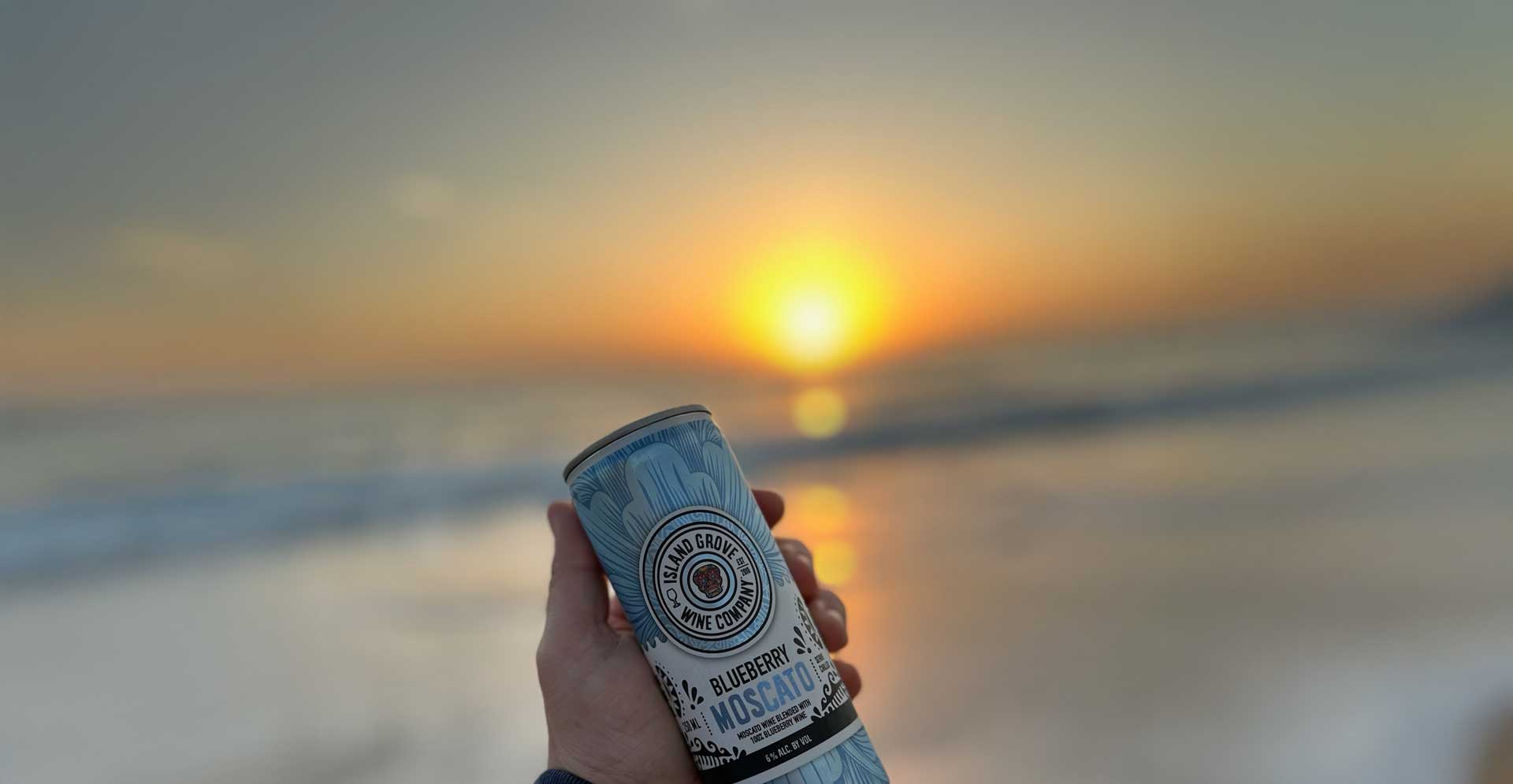
Island Grove puts three wines in 250 mL cans: Blueberry Moscato at 6% ABV, plus Sunshine State Berry Sangria and White Sangria at 11%. On its wine cans page, the winery says the canned Berry Sangria and Blueberry Moscato use the same recipes as the bottles. It gives sealed cans a 12 to 18 month window when they’re kept cool and out of direct light.
All three are fruit-forward and meant to be served cold, which is how cans get used down here anyway: on the boat, at the springs, in the cooler at the game. Not sure which sangria is yours? Here’s Berry Sangria vs. White Sangria.
If you’ve been skeptical, run the glass test on a four-pack. Pour the first can into a glass, drink the second straight from the can, and decide for yourself. You can shop the cans online or find a store near you.
Island Grove makes the wines mentioned in this article; it publishes Taste, and every source above is linked where it is used. If you have a question about a specific can, contact the winery.
Common questions
Does canned wine taste different from bottled wine?
It shouldn't, if it's the same wine and it's been stored well. The can is packaging with a liner between the wine and the aluminum. If the same wine tastes different from a can, heat during storage and sipping straight from the can are the first things to rule out.
Is it okay to drink canned wine straight from the can?
Yes. That's half the point on a boat or a beach. If you want the full aroma, pour it into a glass, but the wine inside is the same either way.
Why does my canned wine smell like rotten eggs?
That's hydrogen sulfide. Cornell researchers found it forms when the molecular form of sulfites in the wine gets past the can's liner and reacts with the aluminum, usually over months of storage. Don't drink it. Tell the store or the winery and note the date on the can.
Do can liners change the taste of wine?
Not directly. A liner's job is to keep the wine off the metal, and what varies is how well it holds up over time. The Cornell research found that liner performance differs between can manufacturers, so the researchers recommend that wineries test a wine in its specific can under long-term or accelerated storage.